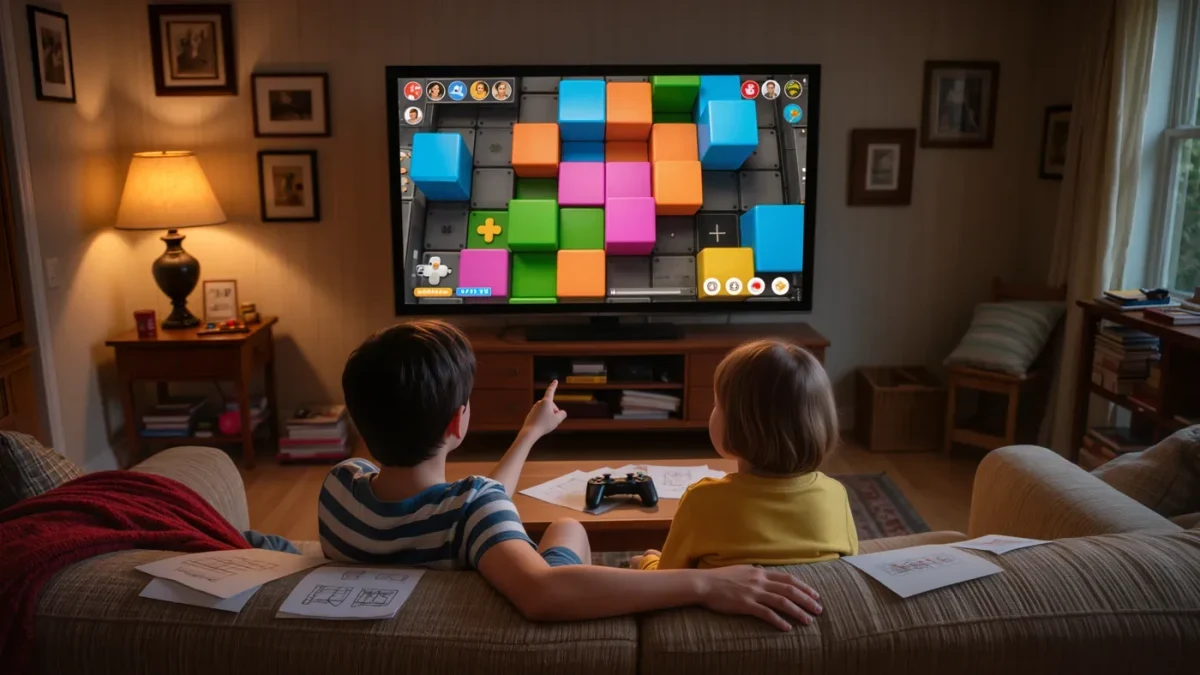
The honest answer from three decades of research: certain video games reliably exercise certain problem-solving skills, and the effect is real but smaller and more specific than either critics or boosters claim. A 2013 review in the journal American Psychologist, surveying a decade of studies, found that players of strategic and puzzle games showed stronger measured problem-solving skills than non-players, while fast action titles showed different, attention-related effects. Genre, not screen time, is the variable that matters. This is information, not advice.
Which kinds of games show cognitive benefits?
Three categories carry most of the positive evidence. Puzzle and logic games — tile-matching, spatial rotation, physics puzzles — exercise planning and spatial reasoning, with effects that transfer to similar pencil-and-paper tasks. Strategy and simulation games, where players manage resources under constraints, show the clearest links to what researchers call ill-defined problem-solving: problems with no single right answer. Action games show the best-documented effects of all, but on visual attention and tracking speed rather than reasoning. What a game trains depends on what it demands.
What did the landmark studies find?
A few findings anchor the field. A 2013 study published in the journal American Psychologist synthesized the research and concluded that puzzle, strategy, and shooter games each showed distinct cognitive benefits, countering the games-rot-your-brain narrative. Work by Daphne Bavelier and colleagues at the University of Rochester found action-game players showed improved visual attention and task-switching. And a 2013 German study using brain imaging found that playing a 3D platform game for 30 minutes daily over two months was associated with growth in brain regions tied to spatial navigation. Each finding is modest, sampled on adults or teens, and about specific skills — none of them says games make children smarter in general.
Does a game genre comparison help?
It does, because the research sorts cleanly by what the game demands of the player.
| Genre | What it demands | Best-supported benefit |
|---|---|---|
| Puzzle / logic | Planning, spatial manipulation | Spatial reasoning, methodical trial and error |
| Strategy / simulation | Resource management, long-term planning | Ill-defined problem-solving, decision trade-offs |
| Action | Fast tracking, rapid switching | Visual attention, task-switching speed |
| Sandbox / building | Goal-setting in open systems | Creativity, planning, iterative design |
| Linear story games | Comprehension, choice tracking | Narrative comprehension more than reasoning |
Notice what's absent: no genre shows strong evidence for transferring to school grades directly. The measured benefits are cognitive skills, and transfer beyond similar tasks remains the field's open question.
What's the difference between grit and grind?
One genuinely encouraging finding: games are among the few environments where children voluntarily persist through repeated failure. Researchers studying motivation note that a child who restarts a difficult level fifteen times is practicing failure tolerance — trying, failing, adjusting strategy — which is the emotional core of real problem-solving. The catch is that games engineer success to feel within reach, and school doesn't always. Talking with a child about how they beat a hard level — what they tried, what they changed — is how you move that persistence from the couch to elsewhere in life. The game teaches the persistence; the conversation teaches the transfer.
What did studies find about the downsides?
The same body of research carries cautions. Excessive play — the literature usually flags markers like displaced sleep and dropped activities rather than an hour count — is associated with worse outcomes across the board, and the American Academy of Pediatrics continues to recommend that parents keep gaming within balanced limits and sleep-protected schedules. Content matters too: the problem-solving evidence comes overwhelmingly from non-violent puzzle, strategy, and building games, not from mature-rated titles. And a 2017 meta-analysis on gaming and cognition concluded effects vary enormously by study design, meaning any single dramatic claim should be read skeptically.
How should a parent use this research?
Three practical takeaways. First, judge games by their demands, not by the word "game" — a city-builder and a violent shooter share a console and little else. Second, treat duration and sleep as the real levers; the risk research is about displacement, not pixels. Third, the conversation about strategy beats limits alone: asking "how did you get past that part?" turns play into reflection. Whether any given game belongs in your home is your call — the research describes averages, and your child is not an average.
The short version
Puzzle, strategy, and building games show the most relevant problem-solving evidence; action games train attention more than reasoning; story games train comprehension. Effects are real, modest, and specific to what the game demands. Protect sleep, judge by genre, and talk about strategy — that's what the research supports, no more and no less.