Ask a room full of working artists and writers what they do daily, and you will hear less about talent than about rhythm. The habits that come up again and again are modest ones: pages written before the household wakes, walks taken without a phone, a workspace cleared enough to think in. None of it is magic, and none of it is a guarantee.
This piece is information, not advice. There is no single routine that makes anyone creative, and what follows is a look at the practices creative people most often report keeping, with an honest note on what they can and cannot do for you or for the young people in your house.
What do creative routines actually share?
Strip away the anecdotes and a few patterns recur. Creative professionals tend to start work at the same time most days, protect a block of undistracted hours, and lower the stakes of beginning. The point of a routine is not inspiration. It is removing the daily negotiation with yourself about whether today counts.
The second shared feature is repetition without drama. Most describe their practice as ordinary, even dull, from the outside. The novelist sits down whether or not the mood arrives. The painter mixes the same colours at the same bench. Over time, the repetition itself becomes the signal that tells the mind it is time to work.
A note on wording, because it comes up constantly in this territory: everyday and every day are not interchangeable. According to Merriam-Webster, the closed form is an adjective, as in "an everyday occurrence," while the two-word phrase means each day, as in writing those pages every day. Small distinctions like this one are exactly the kind of craft detail working writers sweat.
Morning pages: what they are and why writers keep them
Morning pages are handwritten pages, done first thing, with no plan and no audience. The practice was popularised by Julia Cameron in her book on recovering creativity, and it has spread far beyond writers. The rules are simple: fill a few pages longhand, write whatever turns up, and do not reread it for anyone.
What the practice offers, in the accounts of people who keep it, is a way to empty the mental inbox before the real work begins. Worries, grudges, and half-formed ideas go onto the page, where they stop circling. Whether that benefit is real for you is something only a trial week will tell you. Some people find the ritual freeing. Others find it turns into another chore, and quietly drop it.
For parents, there is a version worth noticing: a child who keeps a notebook, doodles in it, writes half a story, abandons it, and returns later is doing a junior version of the same thing. The value is in the returning, not the output.
Walking breaks and the case for deliberate idleness
The walk is the most reliably reported habit in creative life, and it predates every productivity app. Composers, physicists, and novelists alike have described stepping away from the desk and finding the answer waiting at the corner. The mechanism, as commonly described, is that easy physical movement occupies just enough attention to quiet the inner editor, letting background connections surface.
The practical version needs no equipment. A walk without a podcast, without a phone in hand, without a destination, is the form most often described. Fifteen minutes counts. The point is the absence of input, not the mileage.
What experts in attention generally recommend, in broad terms, is alternating focused work with genuine breaks rather than switching from one screen to another. Whether the break is a walk, a chore, or staring out a window is your call. The household that already runs a family digital detox weekend knows the feeling: the first hour is restless, and the second is where the ideas start.
Does the workspace matter, or is the messy-desk myth true?
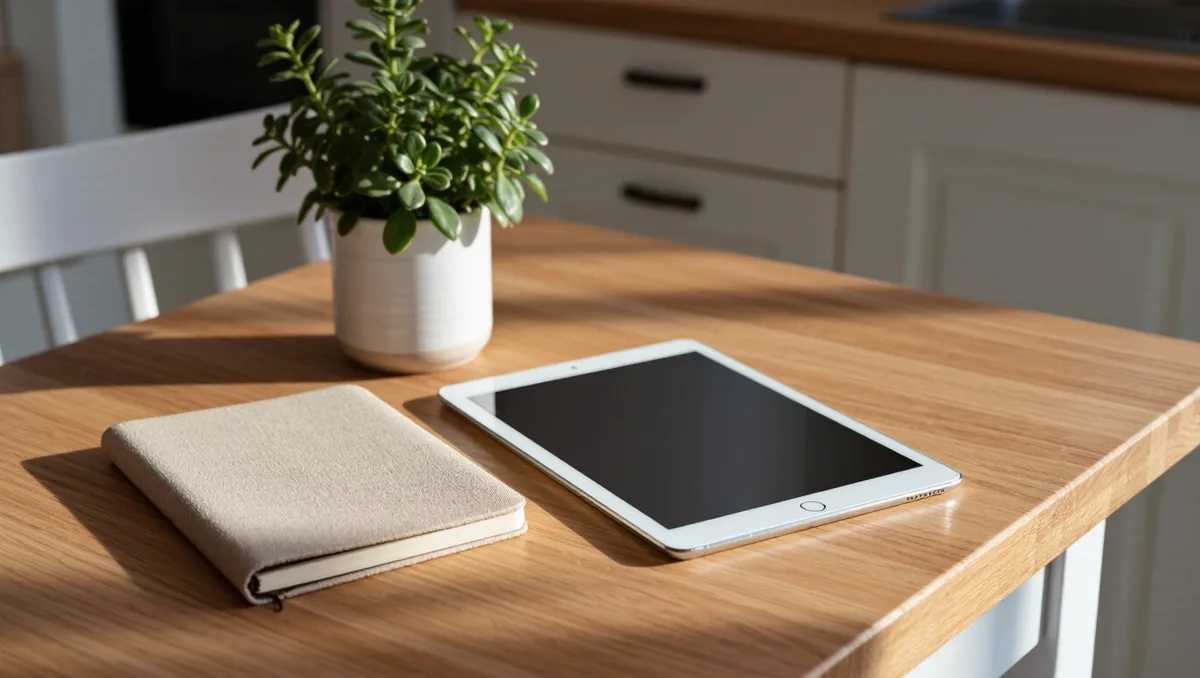
Both camps have famous members, so the honest answer is that it depends on the person. What recurs in practice is not tidiness but function: tools within reach, one clear surface to work on, and nothing that competes for attention during the working block. A desk can be cluttered and still work if the clutter is the work.
Where order pays is in the surrounding room and the start of the session. If the first twenty minutes of creative time go to hunting for a charger or clearing yesterday's dishes, the habit erodes. Our room-by-room guide to decluttering applies here too: the goal is a room that makes the desired behaviour the easy one.
The same logic extends to screens. Many writers describe keeping the phone in another room during the working block, precisely because a device built to capture attention will capture it. For children and teens, the argument is stronger still; a screen-free bedroom setup gives a young person's imagination somewhere to go at night besides a feed. Readers following this should also see A screen-free bedroom setup that helps sleep.
What this means for your household
Our analysis, reading across these accounts, is that the transferable habits are three: a fixed start, a protected block, and a low-stakes warm-up. None require talent, money, or a studio. A teenager drafting a story for twenty minutes after school, at the same spot, with the phone downstairs, is running the same programme as a professional.
What the habits cannot do is manufacture ability, and no honest writer claims otherwise. They lower the friction of showing up. The showing up is still yours, or your child's, to choose. If family media habits are the sticking point, our piece on mealtime media habits covers the research on shared, screen-light routines, and the habits kids pick up from watching you scroll matter more than any rule you set. We covered a connected angle in Coding camps for kids: what they cost and teach.
Whether a morning-pages ritual, a daily walk, or simply a consistent chair belongs in your family's week is, as ever, the family's call.
The takeaway: small, repeatable, unglamorous
The everyday lifestyle habits of creative people turn out to be unglamorous on purpose. A regular start time. A walk with no input. A workspace that works. A notebook nobody grades. Each one is a small bet that showing up repeatedly beats waiting for a lightning strike, and each one can be tried this week at no cost. What remains unknown is which combination suits a particular mind, and the only way to find out is to try one, gently, and see what happens.