Coding camps for kids range from free library-run programs to specialized summer intensives costing as much as an adult conference, and price predicts quality only loosely. What the good ones teach is not a programming language so much as the habits behind one: breaking problems into pieces, debugging patiently, and finishing a project that runs. Computer science education advocacy groups have pushed for broader K-12 access for years, so free and low-cost options have grown. Before you pay anything, know what actually drives the price and what a quality camp looks like from the inside.
What kinds of coding camps exist?
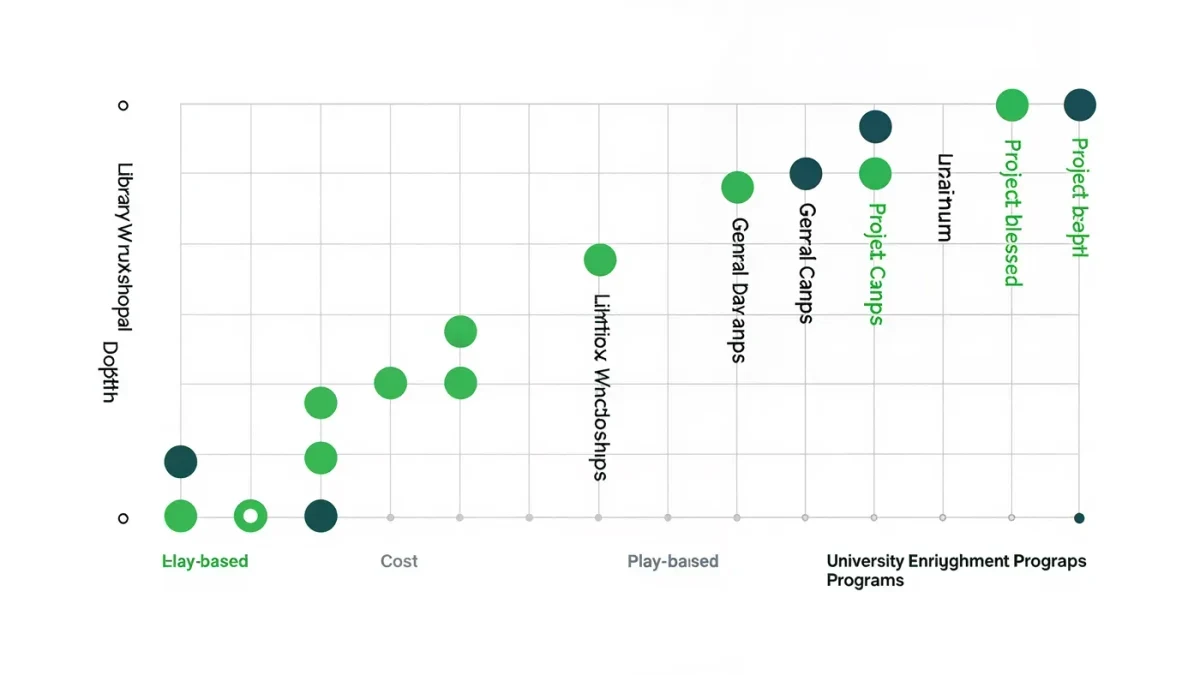
Four broad types cover the market. General-interest day camps bolt an hour of coding onto games and outdoor play — a fine first exposure, light on instruction. Project-based camps center on building one thing, usually a game, a robot, or a simple app, in a week or two. Academic-enrichment programs run by universities or their partners offer deeper content, often in multi-week tracks. And free community options — public library workshops, school clubs, and nonprofit programs such as those supported by national CS-education nonprofits — cover the same ground at no cost. Match the type to your child's interest, not your ambition.
What drives the cost?
Price differences come from staff ratios, equipment, and brand rather than curriculum secrets. A camp with one instructor per six kids, laptops included, and a credentialed teaching staff costs more to run than a volunteer-led library workshop with shared machines — that much is honest math. Beyond that, you are often paying for marketing, an attractive campus, or a brand name. As of the mid-2020s, day camps in most US metro areas commonly run from a couple hundred dollars a week at the low end to well over a thousand for premium specialty weeks, with residential programs higher still; prices vary by region and year, so treat any figure you see as a starting point for negotiation and scholarship asks, not a fact about quality.
What do good camps actually teach?
Look past the language on the brochure — Scratch, Python, JavaScript — and ask what the camper produces. A strong camp is built around projects the child chooses and finishes, with instructor time spent on debugging help rather than lectures. The transferable skills a good week delivers:
- Decomposition: splitting a big problem into small, testable pieces — the core skill of programming and much of engineering.
- Debugging patience: reading an error, forming a guess, testing it, repeating without panic.
- Iteration: version one is rough; shipping and improving beats perfecting.
- Collaboration: pair programming and code review, even in simplified forms.
If a camp's sample schedule is mostly videos or self-paced worksheets with a supervisor in the room, the same content exists free online.
Which age is right for a coding camp?
Visual block-based environments like Scratch are designed for roughly ages eight to twelve, and that is where most children start productively; earlier than that, camps mostly deliver supervised play, which is fine but not instruction. Around eleven to thirteen, text-based languages like Python become accessible, and motivated teens can handle project tracks approaching real development practice. The strongest readiness sign is a child who already tinkers — building in a game editor, automating something, asking how things work — rather than a child who merely likes playing games. Liking games is not liking code, and camps that blur that line are selling to parents.
Are the expensive ones worth it?
Sometimes, and rarely for the reasons advertised. A premium camp can be worth it for a specific instructor, a niche subject like robotics or machine learning for teens, or a peer group that pushes a seriously motivated kid. It is almost never worth it as a first exposure, an attempt to "spark" an uninterested child, or a college-admissions strategy; admissions officers read thousands of paid-camp resumes, and a self-directed project carries more signal than an expensive week. If cost is a stretch, ask about scholarships — many specialty camps keep quiet need-based slots — and check your public library and school district first.
What can we do instead of paying at all?
Quite a lot, if an adult provides structure. Public libraries in many districts run free coding workshops and lend robotics kits; school clubs cover the same beginner ground during the year. Free self-paced platforms teach block coding and Python well, and the gap they leave — deadlines, peers, a helper nearby — can be filled by a small parent-run group that meets weekly to build the same tutorials together. A motivated child with two hours a week and someone to show projects to will outpace a bored child at an expensive camp, every time.
What questions should I ask before paying?
Five questions cut through most brochures. What will my child have built by Friday? Who exactly teaches — credentialed teachers, or high-schoolers on summer break? What is the instructor-to-student ratio during work time? How much of the day is screen instruction versus outdoor or free time? And what is the refund policy if my child hates it by Tuesday? A camp that answers these plainly is usually run by people who teach; a camp that answers in buzzwords is usually run by people who market. The final fit between your child and any given camp is your family's call, and one good free workshop often tells you more than a glossy brochure ever will.