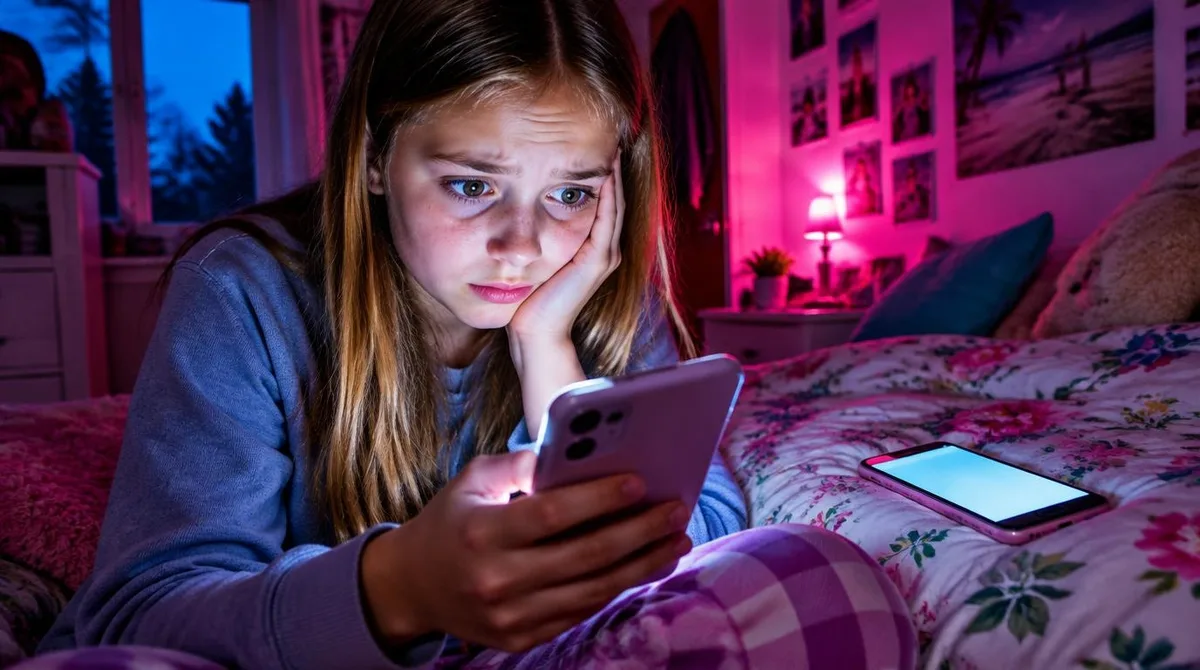
If your child checks a feed one more time "just in case," you have met FOMO without naming it. The fear of missing out is one of the most talked-about forces in young people's online lives. It works hand in hand with another old habit: measuring ourselves against other people.
This article is information for parents and caregivers. It is not psychological or parenting advice. Every family's limits and choices are its own call. What follows is what the research describes, in plain terms.
What FOMO Actually Means
Fear of missing out, or FOMO, is the feeling of apprehension that one is missing out on information, events, or life decisions that could make one's life better. It is tied to a fear of regret. It is marked by a desire to stay continually connected with what others are doing.
As the encyclopedia's summary of FOMO describes it, social networking sites create many openings for the feeling. A feed shows an endless stream of activities that a person is not part of. For a young person still learning where they fit, that stream can feel like a scoreboard they keep losing.
The Old Habit Behind the Screen
Comparing ourselves to others is not new. Social comparison theory was proposed by the psychologist Leon Festinger in 1954. As the reference article on social comparison theory explains, the core idea is that people judge their own opinions and abilities by comparing themselves with others. This helps them reduce doubt about where they stand.
Researchers later added two directions. An upward comparison looks at people who seem to be doing better. A downward comparison looks at those who seem to be doing worse. Both are normal behavior. The feed simply raises the volume, because it supplies a constant flow of comparison material. Much of it was chosen to impress.
Why Feeds Turn Up the Volume
Two platform habits matter here. First, people tend to post about positive experiences, not negative ones. A child therefore sees a gallery of best moments and measures them against an unedited day. Second, the comparison never stops. It is available at any hour, on any screen in the house.
Research summarized in the FOMO literature links the feeling with worse depression and anxiety, and a lower quality of life. A link is not proof of cause, and every child is different. Even so, the pattern is consistent enough to deserve a calm, honest talk at home rather than a panic.
Timing plays a role too. Feeds refresh constantly, and a post can gather praise for hours. A young person watching that counter knows exactly how visible their own last post was, and how visible their absence feels. That awareness keeps the loop running long after the screen goes dark.
What Can Help at Home
Practical steps follow from what the research describes. Naming the feeling helps. A child who can say "I have FOMO right now" is already a step away from it. It also helps to point out that feeds show highlights, not full lives. That teaches a young person to read posts with a critical eye. Predictable offline time helps too, such as meals or a charging spot outside the bedroom at night. It shrinks the stream without turning it into a battle. We covered a connected angle in Screen time and sleep: what the research actually says.
What works for one family may not work for another. Which rule, limit, or app makes sense for your household remains your call. You are the adult who knows your child best.
Conclusion: A Steady Hand Beats a Ban
FOMO and social comparison are not new flaws invented by phones. They are old human habits on a faster stage. The goal is not to erase them. It is to help a child see the stage clearly. A calm explanation of why feeds feel the way they do often outlasts any single rule. Readers following this should also see What is a parasocial relationship, and why does your child feel like a YouTuber is their friend?.