Yes, the research largely supports co-viewing: when a parent watches and talks with a child, children understand more, remember more, and transfer what they learn to screens. Researchers call this joint media engagement, and a 2011 framework from the Joan Ganz Cooney Center at Sesame Workshop put adult-child co-use at the center of how young children learn from media. The American Academy of Pediatrics has echoed the point since 2016, telling families to watch alongside children rather than use screens as a babysitter.
What is co-viewing, exactly?
Co-viewing means sharing the screen with your child and treating it as a shared activity: sitting together, reacting together, and talking about what you see. It ranges from simply being present during an episode to actively pausing and asking questions. Researchers sometimes split this into passive co-viewing, where an adult is nearby but silent, and active mediation, where the adult comments, questions, and explains. The second kind shows stronger effects in study after study.
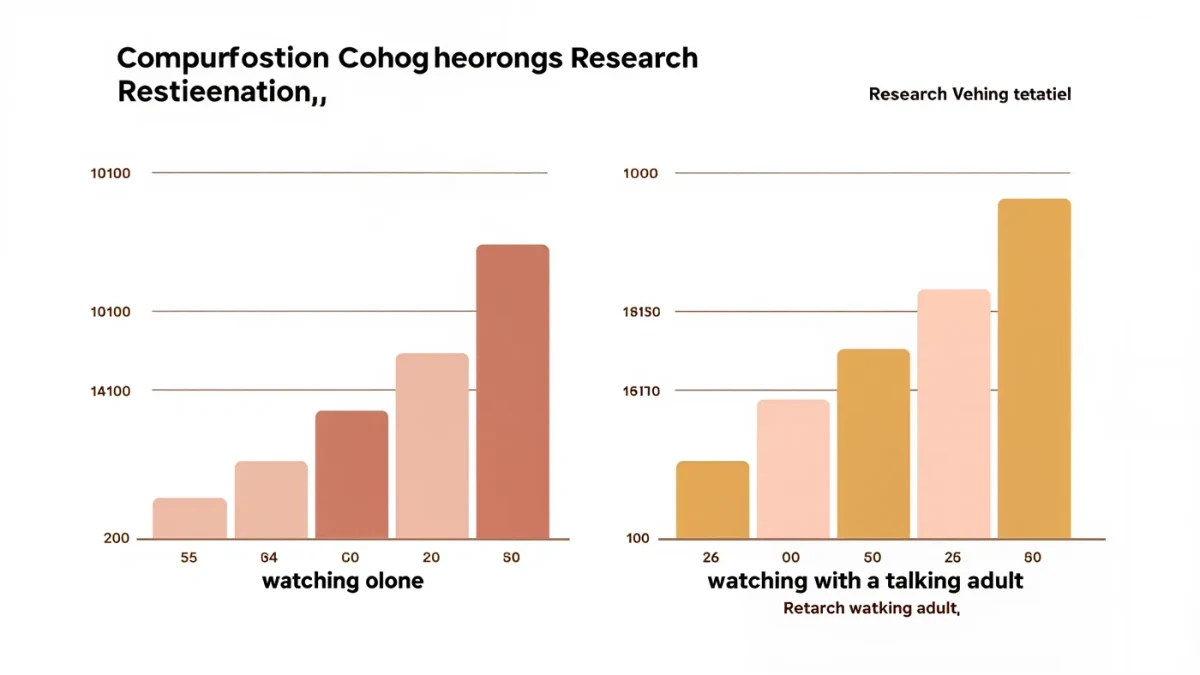
The distinction matters because a warm body on the couch is not the same as a conversation partner. A child watching alone processes a video one way. A child watching with an adult who names things, asks what might happen next, and connects the story to real life is getting something closer to a guided reading lesson, just on a screen.
What have studies actually found?
The findings cluster around three effects. First, comprehension: preschoolers understand storylines and new words better when an adult talks with them during or after a program. Studies of vocabulary learning from video, including work summarized by the National Institutes of Health on early media exposure, repeatedly find that adult scaffolding lifts what children take away. Second, transfer: children are more likely to apply a strategy they saw on screen when an adult helps connect it to their own life. Third, emotional processing: co-viewing gives children a label and a frame for anything confusing or scary.
One line of neuroimaging work is often cited in this space. A 2016 study by Rasmussen and colleagues, published in NeuroImage, used fMRI to compare children's brain responses to stories and video and found different patterns of activation depending on context and condition. Studies like this are suggestive rather than definitive, and the researchers themselves caution against over-reading them. The behavioral literature is the firmer ground: conversation during viewing consistently predicts learning.
Does co-viewing matter as much for older kids?
Less, but not zero. The strongest effects appear under age eight, when children still struggle with what researchers call the video deficit, meaning they learn less from a screen than from a live person. By the tween years, that gap mostly closes, and peers start to matter more than parents in shaping media interpretation. What co-viewing buys you with an older child is different: access, shared language, and credibility. A ten-year-old who watches a show with you will talk to you about that show.
With teens, co-viewing often looks sideways rather than shoulder-to-shoulder. Being in the room while they game, asking genuine questions about a creator they follow, or watching their favorite clips without judgment keeps the channel open. The research on parental mediation of media shows that warm, curious involvement predicts better outcomes than surveillance or lecture, especially as children gain independence.
How do you co-view without turning it into a quiz?
The trick is conversation, not interrogation. Researchers who study shared book reading, and who apply the same lens to screens, describe a pattern called dialogic questioning: short prompts tied to the moment, not a test at the end. A few moves that work:
- Name what you see. "That dragon looks nervous" does more for a three-year-old than any vocabulary drill.
- Predict out loud. "What do you think she'll do next?" builds narrative understanding.
- Connect to real life. "That's like when you and your brother argued about the swing."
- Pause at the loud parts. A ten-second check-in after something scary helps a child file it away instead of carrying it to bed.
- Let silence happen. Talking over every scene is its own problem. Follow the child's cues.
What are the limits of the research?
Honest ones. Most co-viewing studies are small, short, and lab-based, and many rely on parent reports of what happens at home, which tend to flatter the parents. Effects on long-term outcomes like language growth are modest, and co-viewing does not cancel out the well-documented link between heavy evening screen use and poorer sleep, which the sleep literature has held up consistently. A shared hour of fast, loud content at 9 p.m. is still a bedtime problem.
There is also a practical ceiling. Most parents cannot co-view everything, and nobody is asking them to. The realistic version of the research finding is this: prioritize co-viewing for the youngest viewers, for new or unfamiliar content, and for anything with conflict, risk, or emotional weight. Solo, familiar, calm content is a reasonable place to start handing over independence.
Co-viewing versus just limiting time: which wins?
If you force a ranking, the mediation research leans toward quality over quantity, which is also the direction the American Academy of Pediatrics took when it shifted its guidance in 2016 away from rigid hour limits and toward shared, deliberate media use. A hard cap is easier to enforce, and some families need one. But an hour watched together, with conversation, routinely beats two hours watched alone in studies of comprehension and vocabulary.
That said, this is information, not medical or parenting advice, and the right mix for your family is your call. The useful takeaway from the research is modest and encouraging: you do not need to be a perfect media parent. You need to show up, watch what they watch, and talk about it sometimes. Treat this article as information, not a substitute for advice from your pediatrician or your own judgment about your child.