Two years ago, most schools responded to AI chatbots by blocking them; today, many are writing detailed rules about when students may use them. The shift happened fast, and the policy your child's school sends home this year may look nothing like last year's version. Here is what the first wave of real district and state AI policies says, and what it means for homework in your house. This is information, not legal advice.
How did school AI policies start?
With bans, mostly. The Los Angeles Unified School District blocked ChatGPT from its networks in January 2023, then reversed course by June 2023 and began drafting formal guidance instead, issuing its "Guidelines for the Authorized Use of Artificial Intelligence" in April 2024. That arc — from blocking to regulating — is the pattern most large districts have followed, because blocking proved unenforceable once students could reach the tools on personal devices and home networks.
What do the policies actually say?
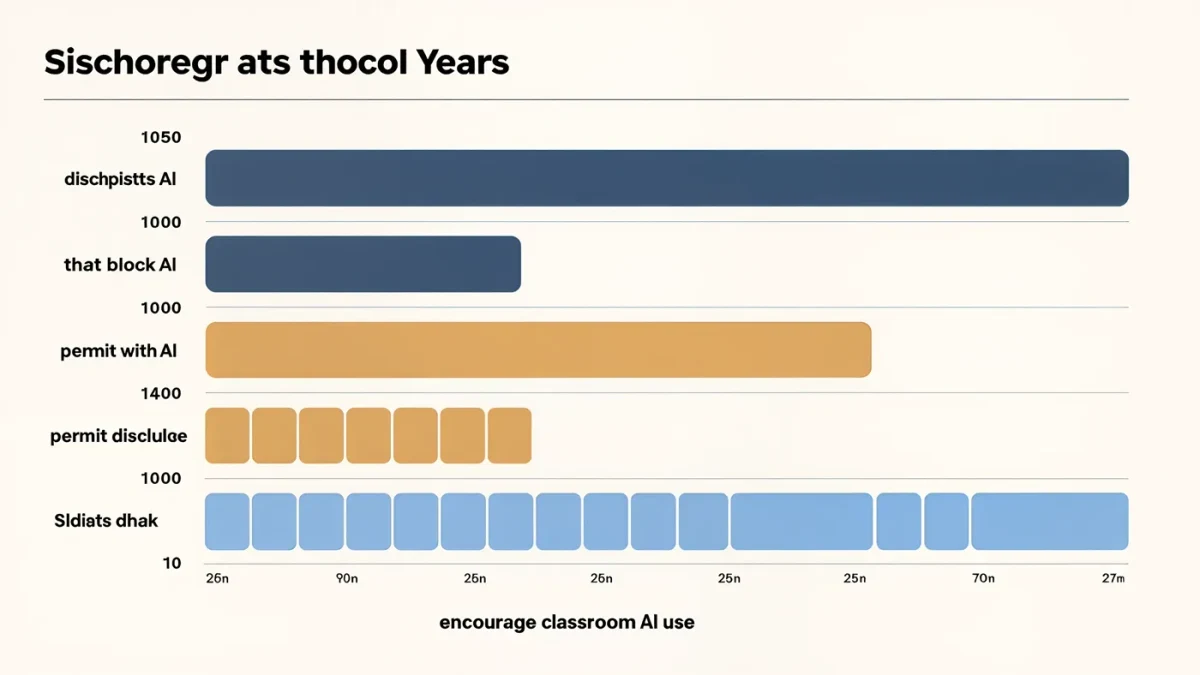
The common elements are consistent across districts that have published rules. AI use is treated like a calculator or a search engine: sometimes allowed, sometimes not, and the teacher decides when. Los Angeles Unified's guidelines bar students under 13 from using district AI tools, mirroring the age minimums built into most commercial chatbots. Many policies also require students to disclose when they used AI and how, similar to citation rules for encyclopedias a generation ago.
Which states have issued guidance?
Per the California Department of Education, the state published "Learning With AI, Learning About AI," a framework for safe and effective AI use in public schools. Oklahoma went further with legislation: a 2025 state law requires districts to adopt formal AI policies by the 2027–28 school year, making written rules a deadline rather than a choice. State education departments across the country have issued AI guidance of some form, though guidance is not the same as a mandate — districts still interpret it locally.
What are teachers allowed to do with AI?
Most policies cover staff, not just students. Districts commonly permit teachers to use AI for drafting worksheets, differentiating reading levels, or speeding up routine communication, while requiring human review of anything that reaches students. The more contested area is AI grading: research summarized by eSchool News in December 2025 found that teachers and AI systems assign different grades to the same work in a majority of cases, which is why some unions have pushed for limits on automated scoring of student work.
What should parents ask at back-to-school night?
- When is AI allowed on assignments — brainstorming, drafting, editing, or never?
- How should your child disclose AI use on their work?
- Does the school use AI detection tools, and what happens after a flag?
- Is AI used to grade or evaluate your child, and who reviews it?
- What is the rule for students under 13, who are barred from most commercial chatbots by the terms of service?
Why detection software is a weak answer
Many families assume schools rely on AI detectors to catch misuse, but the tools are unreliable in both directions. They flag false positives more often for students writing in a second language and for formulaic-but-human prose, and they miss plenty of AI-assisted work. This is why newer policies focus on process — drafts, in-class writing, oral check-ins — rather than on software verdicts. If your child is accused based only on a detector score, it is fair to ask what other evidence supports the accusation.
What about younger students?
Elementary policies are simpler because the age minimums do most of the work. Since most commercial chatbots require users to be 13 or older, schools serving younger children generally route AI through teacher-controlled tools rather than student accounts. When AI appears in a K-5 classroom, it is usually the teacher operating it on a projector — generating a story starter, for example — rather than children prompting a chatbot themselves. If a younger child wants to experiment at home, sitting with them and typing prompts together keeps the activity inside your view.
Three scenarios, three different answers
Consider how differently one tool behaves across assignments. Using a chatbot to explain a confusing physics concept the night before a test is tutoring, and most policies permit it. Pasting an essay prompt in and submitting the output is plagiarism under essentially every published policy. Asking AI to quiz your child on Spanish vocabulary sits in between, and many teachers encourage it. Walking your teen through these distinctions once is worth more than a blanket rule, because the boundaries will follow them to college and to work.
What changed during 2025
The tone of the debate shifted. Early arguments treated student AI use as a cheating problem; by 2025, states and districts were framing it as a skills problem — teaching students to question AI output, verify sources, and recognize when a tool is confidently wrong. That reframing matters for parents, because it means the question is no longer only whether your child used AI, but whether they can use it competently and honestly. Schools that updated policies during 2025 tend to spell out both halves.
How to talk about it at home
The most useful framing for teens is that AI is a tool with a setting problem: right in some contexts, wrong in others, and the school's syllabus is the rulebook. Experts recommend making the conversation practical rather than moral — ask your teen to show you how they would use a chatbot for a specific assignment, then compare that with what their teacher allows. Whether AI belongs in your child's homework routine at all is your family's call; the school's job is only to set the expectation inside the classroom.
Policies will keep changing, and the districts updating them most thoughtfully are the ones inviting parent input. If your school has not communicated a clear rule yet, asking for one is reasonable — and, per the Oklahoma approach, eventually it will not be optional.