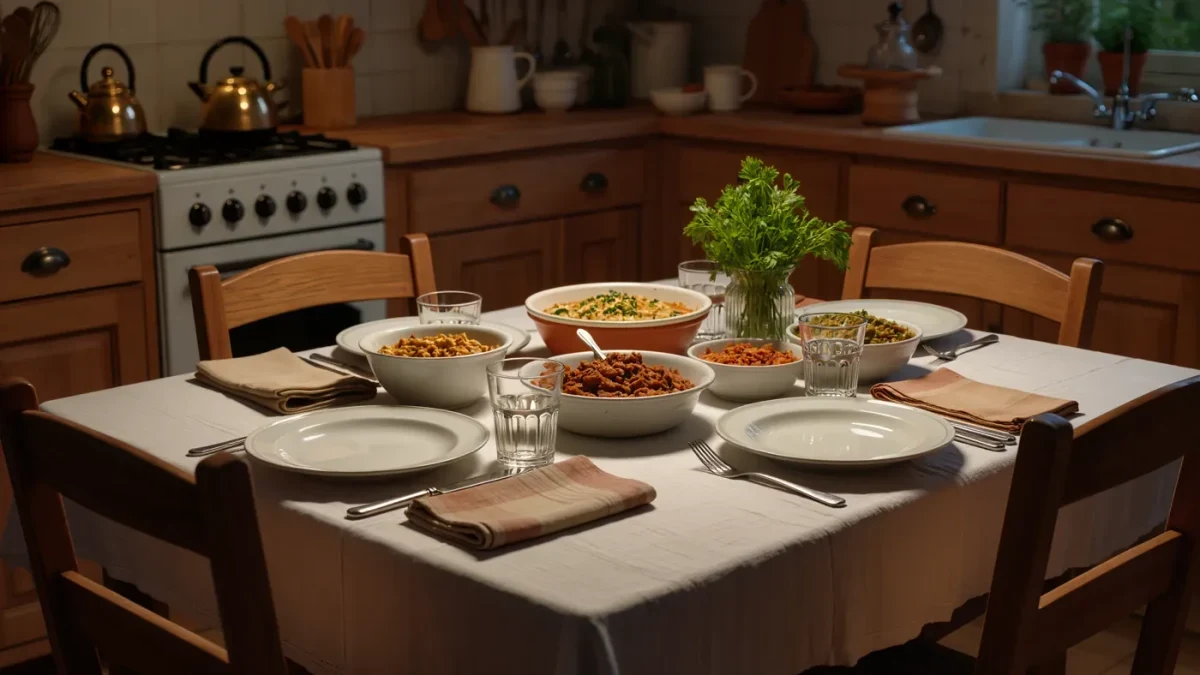
Screens at meals are one of the most-studied corners of family media research, and the direction of the findings is fairly consistent: eating in front of a screen is associated with poorer diet quality and less family conversation, and the American Academy of Pediatrics recommends making meals a screen-free time. That is the research. The practice is harder — tired children, working parents, and the irresistible pull of a show that buys twenty quiet minutes. This is information, not medical advice, and the final mealtime rules are your family's call.
What does the research actually suggest?
Three findings recur across studies. Screen use during meals is linked with eating more and eating less attentively — researchers call the mechanism distraction, since satiety cues get missed while attention is on the show. Diet quality tends to be lower in households where meals regularly happen in front of a screen, though causality runs both directions: busy families reach for screens and fast food for the same reasons. And mealtime conversation drops when a device is on, which matters because shared-table talk is one of the strongest everyday predictors of children's language development and family connectedness. None of these findings are about one meal; they are about patterns.
What about background TV during dinner?
Background television is the sneaky version of the problem. Even when nobody is watching, a running TV lowers the quality of interaction at the table — conversation turns shorter and more logistical when a screen competes for attention. Families often keep the news on at dinner out of habit; if that is your house, try a week with audio only, music only, or nothing, and watch what happens to the talk. The comparison is usually persuasive on its own. The same logic applies to the parent's phone on the table: children notice whether adults follow the mealtime rule, and they follow the behavior, not the rule.
Are screens at meals ever reasonable?
Yes, and pretending otherwise makes rules brittle. Reasonable exceptions families actually use: a family movie-and-pizza night, which is shared viewing rather than solo distraction; illness and travel days; a truly exhausting Friday where the alternative is worse. The difference between a sustainable habit and a slippery slope is that exceptions are named as exceptions. "Friday pizza night has a movie" is a ritual; "screens whenever dinner is hard" is a default in disguise. If you notice the exception appearing most nights, that is the signal to reset, not to feel guilty.
How do you run a screen-free mealtime rule?
Make it structural rather than verbal. Devices park at a charging station before anyone sits down, including yours. Fill the vacuum with something easier than a screen: a low-stakes question everyone answers, music, or a rotation where each person picks the dinner topic. Two conversational tools do a lot of work: highs and lows (each person names the best and hardest moment of the day), and open questions about their world rather than interrogation about homework. Expect the first week to be bumpier than the second. Toddlers and teenagers protest differently, but both settle once the rule is boring and stable.
Do restaurant screens count?
Restaurants are where many families relax the rule, and a tablet at a long dinner is a defensible survival tool for toddlers. The same research logic applies, though: a child watching a show at the table is not practicing the restaurant skills of ordering, waiting, and chatting, and those skills only develop through practice. A middle path many families use — devices stay away until food arrives, or only after the meal while adults finish talking — keeps the social practice while shortening the hardest stretch. Whatever you choose, decide before you sit down; negotiating at the table with a hungry child is a losing opening.
What about toddlers specifically?
Toddlers are the age group where mealtime screens do the most work and cost the most. A show reliably keeps a toddler in the chair, but mealtime is also one of the richest language settings a toddler has — food names, colors, reactions, requests. Research on early language development consistently points to serve-and-return conversation with adults as the engine of vocabulary growth, and a screen pauses that exchange. If you use a screen to get through certain meals, keep others screen-free and conversation-rich, and aim the trajectory toward fewer, not more. Small children adapt to whatever the routine is; they simply need the routine to be consistent.
What if meals are short and chaotic?
Short is fine — ten focused minutes beats forty with a screen. If weeknight dinners are fragmented by schedules, pick the one meal the family reliably shares, even if it is breakfast or a weekend lunch, and protect that one as screen-free. Research on family meals generally finds the benefits come from frequency and connection, not from formal dinners or cooking ambition. A Tuesday breakfast where everyone talks for ten minutes is doing the work the research describes. Do not let the perfect dinner sabotage the achievable one.
What should we change first?
If you want a single change with the largest return, remove the background screen and park the phones, keeping everything else as is for two weeks. That removes the distraction mechanism without asking anyone to change what they eat. Notice the difference in conversation volume and how long people linger, then decide as a family whether to go further. The research gives the direction; your family chooses the pace. And if mealtime conflict over screens stays severe, or eating itself becomes a battleground, that is a conversation for your pediatrician rather than a media-rules article.