Keep calls short, make them active instead of conversational, and accept that a toddler will wander. Researchers who study young children and video, including teams whose work is summarized by the National Institutes of Health, describe video chat as the one screen exception even strict guidance makes: the American Academy of Pediatrics has carved video calling out of its under-two limits since 2016 because it is social interaction, not passive viewing. The trick is engineering the call so a two-year-old can actually succeed at it.
Why do toddlers struggle with video calls?
Because a video call violates most of what toddlers rely on to communicate. They cannot make eye contact on a screen, they read faces by climbing into laps, and they cannot point at things the other person can see. Speech and language researchers note that toddlers under about two and a half learn poorly from recorded video, a pattern called the video deficit. Live video partially escapes it because the person responds in real time, but the lag and the small image still make demands a toddler's attention cannot always meet.
The result is the call every parent recognizes: ninety seconds of shy staring, one waved teddy bear, and then the toddler is gone, leaving a grandparent talking to an empty room. That is not failure. That is a toddler processing a genuinely strange form of presence at their own pace.
How long should a call last?
Plan for five to ten minutes for a one- or two-year-old, and treat anything longer as a bonus rather than a goal. Attention spans at this age are measured in minutes, and a call that ends while the child is still engaged leaves a warm memory. A call stretched to twenty minutes because the adults are enjoying it usually ends in tears or abandonment, and teaches the toddler that calls are boring.
Frequency beats duration. Two short calls a week build the relationship better than one long one, because toddlers live on repetition. A grandparent who appears every Tuesday and Saturday becomes predictable, and predictability is what converts a stranger on a screen into a person the child runs toward.
What should grandparents actually do on the call?
The single best upgrade: move from asking to showing. "How are you" is a dead question for a two-year-old. Demonstrations work:
- Show an object. A slow tour of whatever is on the windowsill, a silly hat, the dog's new trick.
- Play parallel games. Both sides build with blocks or stack cups, and the toddler watches the screen version while making their own.
- Read the same book. Grandparent holds their copy, toddler has theirs; page turns sync surprisingly well.
- Sing. Songs with gestures, like itsy-bitsy spider, survive time lag far better than conversation.
- Mirror snack time. Both eat the same fruit at the same time. Toddlers find this hilarious and it requires no talking.
None of this requires technical skill from the grandparent. It requires a script change from interview to playdate, and most grandparents make it instantly once someone tells them the pressure to converse is the problem.
What setup makes calls easier?
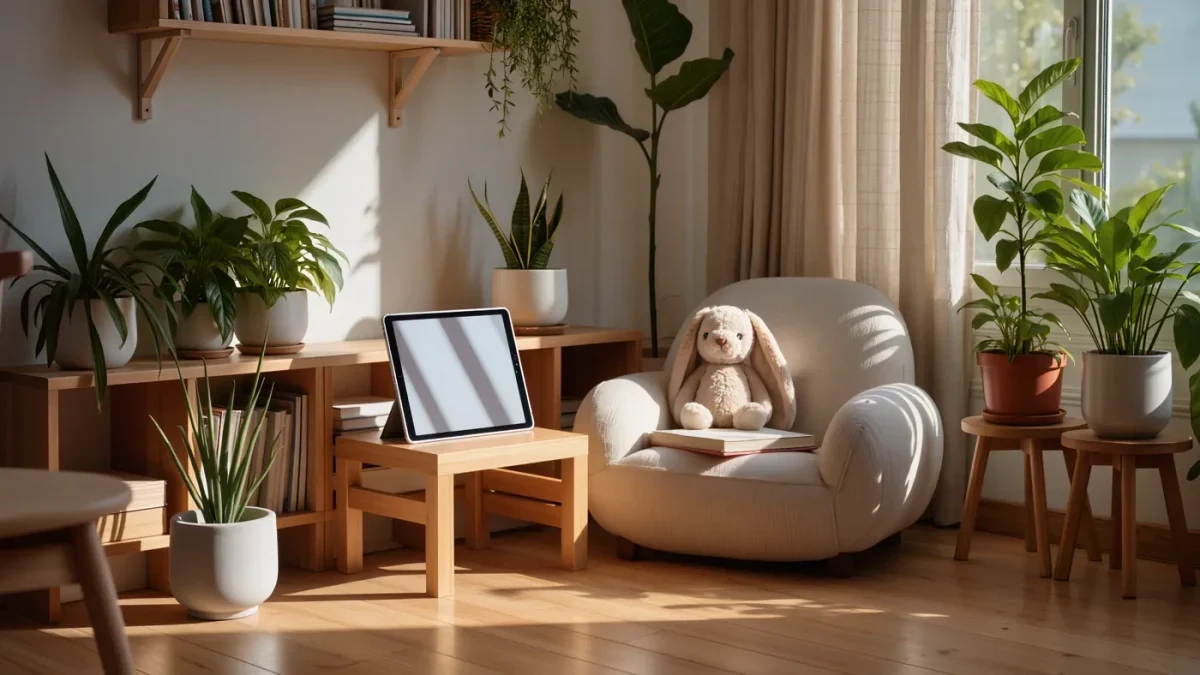
Small logistics matter more than apps. Prop the device at the child's eye level rather than flat on a table, so faces align. Sit slightly behind or beside the toddler so the grandparent sees the child's face, not the ceiling. Choose a fixed spot, the same chair, the same corner, so the routine itself signals what is happening. Close other apps, and put pets in another room if the goal is conversation rather than chaos.
Timing is the other half. Call when the child is rested and fed, typically mid-morning, never in the pre-dinner wound-up hour or five minutes before bed. A call right before bedtime often backfires twice: the toddler is cranky, and the stimulation pushes sleep later, and the link between evening screens and harder bedtimes is one of the more consistent findings in the sleep research summarized by agencies like the National Institutes of Health.
How do you help the toddler know who this person is?
Between calls, keep the grandparent visually present. Print a photo for the fridge, mention them by name in ordinary conversation, and let the toddler see the parent talking to them happily. Researchers who study grandparent contact in separated families consistently find that the child's comfort tracks familiarity, not blood. A face seen twice a week on screen and daily in a photo frame becomes family; a face seen monthly stays a stranger for far longer.
After the call, narrate it the way you would an outing: "You showed Grandma your dinosaur. She liked the dinosaur." Toddlers consolidate memory through retelling, and the retelling is often where the relationship actually grows.
What about calls with multiple grandchildren or distant time zones?
Multi-child calls are hardest on the youngest, who gets talked over. If siblings share a call, give the toddler the first five minutes alone with the grandparent, then bring in the older children with their own agenda. Time zones deserve pragmatism: anchor to the toddler's best window, and let the adults absorb the inconvenience, because a 7 a.m. call that lands at the child's happy hour beats a 8 p.m. call at the grandparent's convenience.
Every family's setup differs, and this is information, not developmental advice; your pediatrician knows your child. But the pattern that works is stable across households: short, frequent, playful, predictable calls, led by a grandparent who shows up with a book and a silly hat instead of questions. The toddler staring silently at the camera is still building a relationship. Treat the awkwardness as a phase, not a verdict.