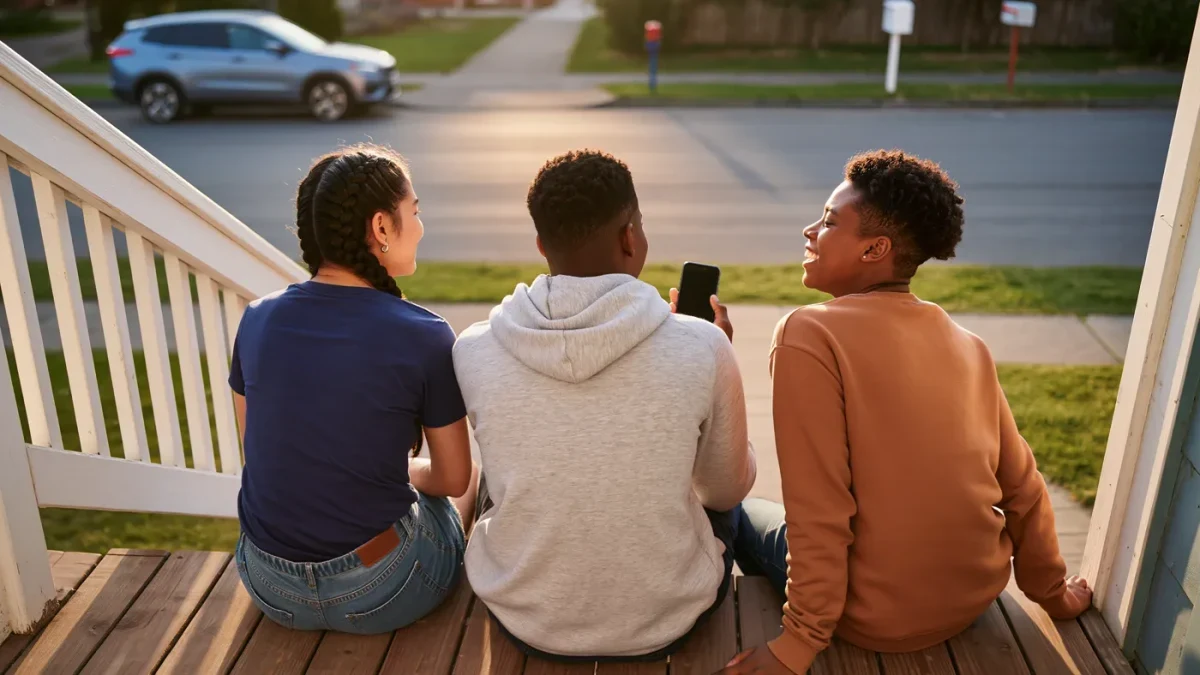
A "finsta" is a second, private Instagram account used for a small circle of real friends, while a teen's main account — the "rinsta," for real Instagram — stays polished for a wider audience. The word blends "fake" and "Instagram," but the account is not deceptive in the way that sounds: it is where teens post unflattering photos, jokes, and ordinary complaints without performing for classmates, colleges, or relatives. Think of it as the digital equivalent of talking with your closest friends at home. This is information, not parenting advice.
Why do teens want two accounts at all?
Because one audience became several. A main account is watched by peers they barely know, extended family, coaches, and sometimes admissions officers, and maintaining that surface is tiring. A finsta resets the audience to a dozen trusted people, where a bad haircut photo is funny instead of embarrassing. Researchers who study adolescent identity describe this as audience segregation — keeping different social contexts separate — which teens manage online in roughly the way adults keep work and personal lives apart.
What actually gets posted on a finsta?
Mostly the unremarkable material of daily life, which is the point. Common posts include self-deprecating photos, complaints about school or sports, inside jokes with friends, and "photo dumps" — uncurated batches from a week. Some finstas exist for a single interest, like a fandom or an art style the teen does not want on the main account. What rarely belongs on any account, private or not: anything that would be a problem if screenshotted, because privacy settings limit visibility but not forwarding.
Is having a finsta a red flag?
Usually not. Privacy from parents and privacy from peers are different projects, and a teen keeping a small friends-only account is exercising ordinary social judgment. The context that warrants a closer look is change: a teen suddenly withdrawing from the main account they loved, hiding all screen activity when that was never the pattern, or pairing the second account with mood changes. Even then, the conversation starter is the mood change, not the account. Experts on adolescent media use generally recommend curiosity over confrontation.
Where the word came from
The term appeared on college campuses in the mid-2010s and spread downward to high schools within a few years, which makes it old enough that some teens now consider it a parent-era word — the function survives even where the name has faded. Whatever it is called this year, the pattern is stable across platforms: a public-facing account and a small private one, whether that means a second profile, a close-friends story list, or a private account with a nickname. Asking your teen what their generation calls it is a decent opening, and a reminder that the behavior outlasts the vocabulary.
The difference between a finsta and a burner
A burner account is built for anonymity — posting without any connection to the teen's real identity — while a finsta is built for intimacy, using a jokey handle that close friends instantly recognize. The distinction matters because anonymity changes what people are willing to post, and not usually for the better. If a teen you know runs an anonymous account that comments on classmates, that is a different conversation from a friends-only photo dump, even though both involve a second profile.
What can go wrong with a finsta?
- Screenshots travel: a private post can be shared beyond the circle in seconds.
- Follower creep: the account grows, and the trusted audience quietly stops being only close friends.
- Permanence: nothing posted anywhere is truly temporary, including on private accounts.
- Exclusion dynamics: knowing which friends are on the finsta carries its own social weight.
How does this connect to platform rules?
Through age minimums, mostly. Instagram requires users to be at least 13, following the threshold set by U.S. children's privacy law, so a finsta is simply a second account under the same rules — it does not require a fake age unless the teen is younger than 13 to begin with. If you learn a child under 13 has any account, the issue is the age minimum, not the finsta format. Platforms also offer official tools like "close friends" stories that replicate some of the function, which some teens use instead of a whole second account.
A note on group chats
Much of what once filled a finsta has migrated to small group chats, which now serve the same audience of a dozen trusted friends without any posting pressure at all. If your teen seems to have no second account, check their chat list before concluding anything — the private room may simply have changed shape. The skill you want them to carry is the same either way: knowing the difference between an audience and a witness.
Should parents ask to follow the finsta?
That is your family's call, and the honest answer is that demanding access usually changes what the account is for. Many families land on middle ground: teens keep the finsta private, parents stay on the main account, and the deal includes an agreement about what never gets posted anywhere. The conversation worth having is not "show me" but "what would you do if a finsta post got screenshotted and shared?" Teens who can answer that question are already doing the risk assessment you wanted them to learn.
Questions to ask instead of 'show me your accounts'
- Who is your finsta actually for, and how did you pick the list?
- Has anything from a private account ever leaked to the main one?
- What would make you delete a post yourself?
A finsta is often a sign your teen understands audiences better than the panic headlines suggest — they built a small room inside a loud building. Treat it as evidence of developing judgment, and save your attention for the moments when their offline behavior asks for it.