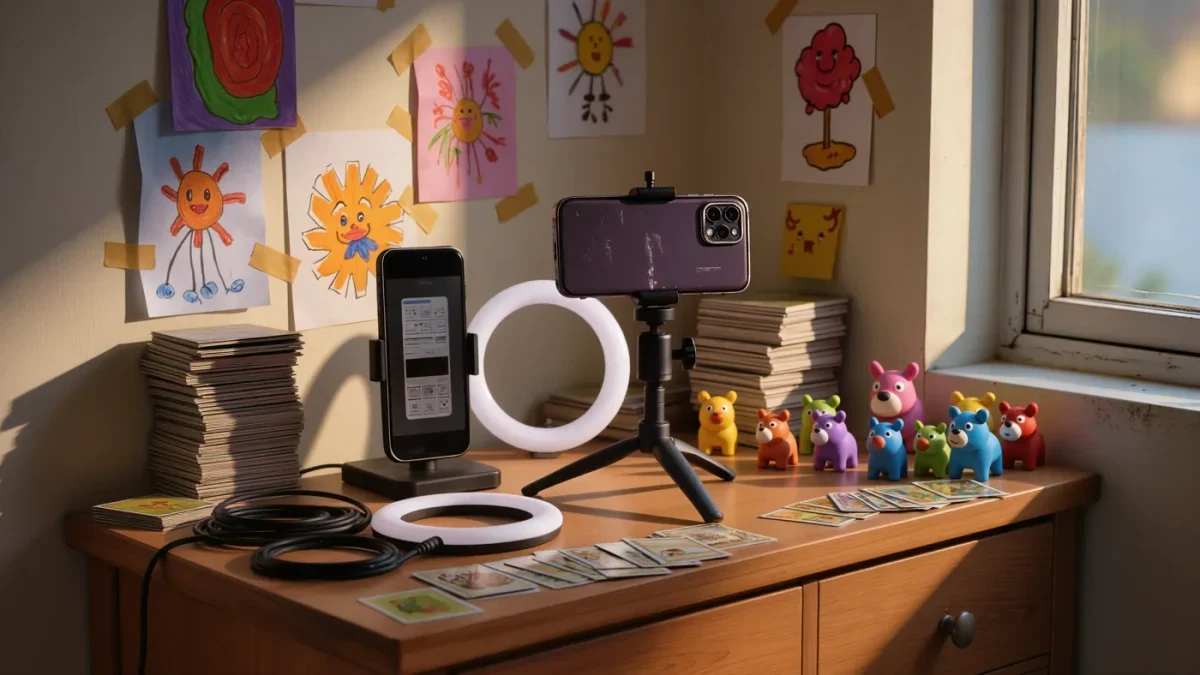
Imitation is how children learn, and YouTube is a catalog of imitable behavior. Pew Research Center surveys have found that the overwhelming majority of American teens use YouTube, and younger children follow close behind on kids' versions of the app. Most copying is harmless — a catchphrase, a drawing style, an exaggerated intro. A few patterns deserve closer attention: challenge videos, unboxing culture, and pranks. Knowing what these formats teach, and what they quietly normalize, lets you respond with curiosity instead of alarm.
Why do kids copy creators so closely?
Children are wired to copy models who look successful, and creators are professional models of enthusiasm. The format makes imitation especially sticky: the same host appears daily, speaks directly to the camera as if to a friend, and repeats signature lines across hundreds of videos. Researchers describe this one-sided bond as a parasocial relationship — the child feels they know the creator, even though the creator has never heard of them. That sense of familiarity is exactly why a child may defend "their" creator's behavior as fiercely as a friend's, and why a calm question works better than criticism.
What's the deal with unboxing videos?
Unboxings teach two habits by repetition. The first is wanting: watching toy after toy opened trains an association between excitement and acquiring, which is why the format is essentially advertising wearing entertainment clothes. The second is aspiration: many children don't just want the toy — they want to be the one opening it, and may start filming their own unboxings. That ambition can be creative, but the underlying lesson, that stuff equals content equals attention, is worth naming out loud. A useful family rule: wishes inspired by an unboxing go on a list, not into a cart, and revisit the list together after two weeks, before anything is bought. Most of it evaporates, which teaches the lesson better than any lecture could.
When should a challenge video worry me?
Challenges exist on a spectrum from silly to dangerous, and the risky ones are rarely labeled as such — the danger is the point. Watch for challenges involving swallowing or eating non-food items, holding breath, medication, fire, heights, or driving stunts; these have caused serious injuries and deaths documented in news reporting. Ask your child open questions: what is the challenge, what could go wrong, would they do it with you watching? Children often can spot the risk themselves once asked directly. Also watch for dare chains that spread through school peer groups even after fading online, and for misinformation stunts that ask kids to test or eat something to prove a claim.
What about pranks?
Prank content teaches that other people's distress is entertainment. The format quietly blurs consent: the target did not agree to be filmed, and the camera frames their reaction as the payoff. Children who watch a lot of pranking may try it at home or school, where the targets are siblings and classmates who experience it as humiliation rather than comedy. A good conversational wedge is the reversal: "How would you feel if that happened to you and everyone laughed?" Some families adopt a simple rule — pranks are allowed only if the target laughs too, and filming anyone requires their okay first.
Is it a problem if my child wants to be a creator?
Usually not — it can be a genuine creative spark. Filming, editing, scripting, and performing are real skills, and plenty of family projects start this way. The healthy version happens offline-first: making videos with you, for grandparents, using free tools, with no public upload until the child is old enough for the platform's own age rules and understands what public means. The version worth slowing down is a child optimising everything for an audience — asking what will get views rather than what they want to make. If their identity starts depending on view counts, that is a conversation, not a confiscation.
Which copied behaviors cause trouble at school?
Teachers report a familiar shortlist: slang and insults imported from videos, physical gags like shoulder-taps and "hit a pose" interruptions, and shock humor that sounds funny in a clip and lands as disruption in a classroom. None of it is malicious — the child is rehearsing a script that earned laughs online, without the context to know why the setting changes the meaning. The fix is context, not vocabulary bans. "That line works in a video; at school it reads as rude" gives the child a portable rule they can apply to the next catchphrase too. If a teacher flags a copied behavior, ask which video it came from and watch it before deciding how concerned to be; you will usually find it was imitative rather than defiant.
How do I talk about this without a fight?
Lead with curiosity about the content, not judgment of the child. Watch a few of their favorite videos yourself, even the loud ones, and ask what they enjoy. When something concerns you, describe the pattern rather than attacking the creator — "I noticed the prank target didn't seem to be having fun" lands better than "this guy is terrible." Children defend creators they feel connected to; they can evaluate behaviors when given space. And keep the rules visible and shared: what's fine to copy, what needs a check with you first, and what's never okay. Your family's line is your call; the conversation is what keeps it honest.