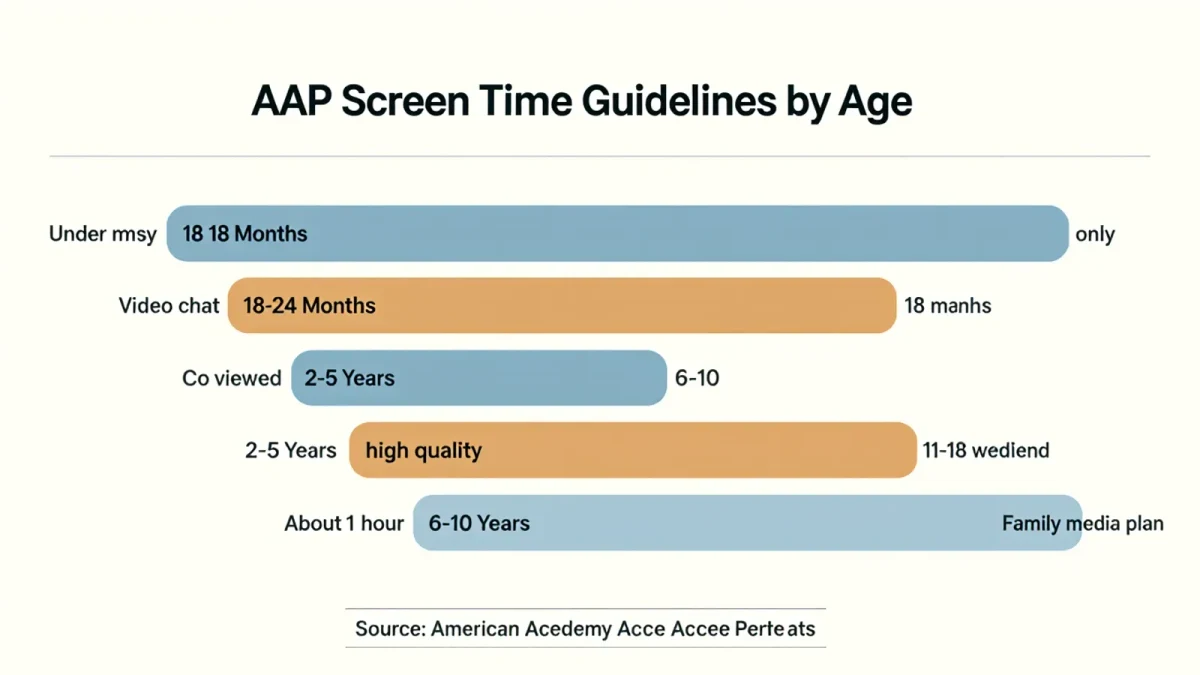
Set one family media philosophy, then apply it in age bands rather than writing a separate rulebook per child. The American Academy of Pediatrics abandoned one-size-fits-all hour caps in 2016 and moved toward an individualized family media plan, precisely because a toddler, a fourth grader, and a teenager have different needs. The practical version: hold the principles constant, scale the privileges, and explain the difference in terms of readiness, not favoritism.
Why one shared rule rarely works?
Because media is developmental. A four-year-old is still learning symbolic thought and cannot distinguish an ad from a show. An eight-year-old can follow a story but not spot manipulation. A thirteen-year-old can read a privacy policy in theory but rarely does, and faces social pressure that a younger sibling cannot imagine. A single hourly limit across that spread will either bore the teen or overwhelm the preschooler.
One caution from families who have run this system for years: write the bands down somewhere visible. Unwritten rules drift, and drift is where the fairness fight lives. A photographed copy of the family media plan, stuck to the refrigerator and updated at each review, gives any sibling the power to cite the rule without escalating to a parent, which is quietly the biggest conflict reducer available.
What siblings do need is consistency. Children monitor fairness with forensic intensity, and they accept different rules far better than they accept arbitrary ones. The phrase that carries the load in most families is some version of "rules follow readiness, not birthdays alone": privileges expand as a child demonstrates handling the previous level, the way car seats and bedtimes already scale.What does an age-banded framework look like?
A workable banding, aligned with the AAP's family media plan structure, looks something like this. Treat it as a starting draft, not a prescription:
| Age band | Core rules | What the child controls |
|---|---|---|
| 2 to 5 | Co-view with an adult when possible; content chosen by parents; screens end an hour before bed | Choosing between two parent-approved options |
| 6 to 9 | Defined windows for entertainment; games and shows from an approved list; devices used in shared spaces | Picking the order of activities inside the window |
| 10 to 13 | Own profile, parental controls on; a first phone or social app only with a written agreement | Managing their own schedule within weekly totals |
| 14 and up | Negotiated curfews; ongoing conversations replace most technical limits | Nearly full control, with known consequences |
The bands matter less than the transparency. Post the framework on the fridge, revisit it every school year, and let children advocate for changes. A rule a child helped write is a rule a child defends.
How do you handle the younger sibling who wants what the older one has?
This is the pressure point in almost every household, and the honest answer is that you cannot fully defuse it. You can manage it. First, stop framing the teen's privileges as rewards; frame them as tools tied to responsibilities, like a later bedtime tied to being able to wake for school. Second, give the younger child a genuine "yes" territory of their own, something the older sibling does not get, whether that is choosing the Friday movie or extra one-on-one time with a parent.
Third, hold the line on content even when it is inconvenient. The research on media ratings and child development, including long-running work summarized by the National Institutes of Health, links age-inappropriate content, especially violence and horror, with sleep problems and fear in younger children. An eight-year-old watching a twelve-rated game because the twelve-year-old plays it is the single most common breach in families, and the one most worth resisting.
Should siblings have separate devices and profiles?
Yes, wherever the budget allows, and it is cheaper than it sounds. Separate profiles on a shared tablet cost nothing and solve three problems at once: age-appropriate storefronts, accurate watch histories that do not poison recommendations, and clean accountability when a rule is broken. A shared YouTube profile quickly becomes a brawl of competing algorithms, and the toddler ends up with recommendations built for the tween.
Physical hand-me-downs are fine with two cautions. Wipe and reset the device so the younger child starts clean, and re-check the parental controls for the younger age band rather than inheriting the older child's permissions. Many families forget the second step and discover a nine-year-old with a thirteen-year-old's app library.
How do you enforce rules without playing referee all day?
Shift from policing to structure. The families that report the least conflict tend to share a few habits. They use the router or the device's built-in tools to enforce shutdown times, so the device says no and the parent does not have to. They run screen time as a weekly budget rather than a daily ration, which lets an older child save up for a weekend marathon and teaches self-management. And they keep one non-negotiable that applies to everyone equally, most often no devices at dinner or in bedrooms overnight, including, visibly, the parents' phones.
That last point is not decoration. Children calibrate their sense of what is normal from adult behavior, and a parent who scrolls through dinner while enforcing a child's curfew loses credibility fast. Modeling is the cheapest enforcement tool available.
What happens when the rules need to change?
Rules set in August rarely survive February intact, and that is fine. Build in a scheduled review, every six months or at each school transition, and treat rule changes as promotions earned rather than concessions extracted. When a younger sibling leaps ahead, say so explicitly: "You showed you can stop without me reminding you, so your weekend window is longer." When something fails, a broken agreement, a disturbing discovery, a slump in sleep, tighten one thing at a time and name the review date so it does not feel like a permanent punishment.
Every family draws these lines differently, and the research supports principles far more than specific numbers. This is information, not parenting advice: your family's exact bands are your call. What the evidence does suggest is that children thrive with rules that are explicit, scaled to readiness, and enforced with the same consistency for the seven-year-old and the seventeen-year-old, including the adults who pay the phone bill.