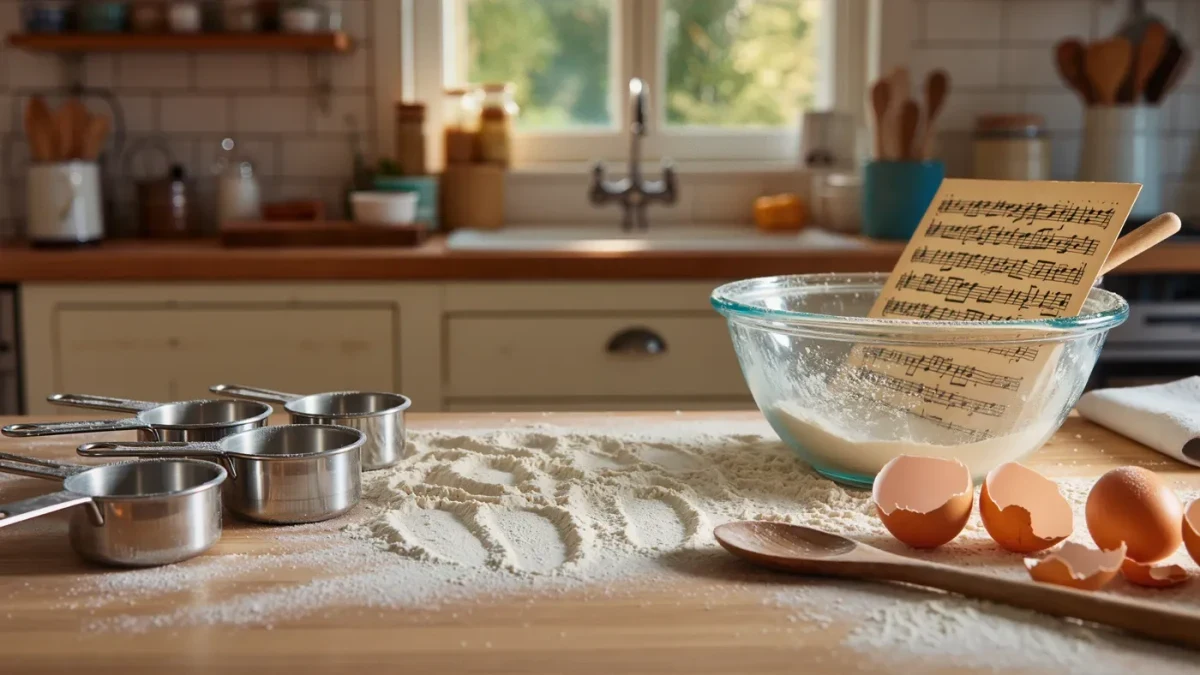
Cooking is one of the densest everyday math environments a child will ever encounter, and the research on informal math learning says the kitchen counts. Studies of home numeracy — including work summarized by the National Institutes of Health's early math portfolios — consistently find that children whose families do everyday math talk enter school with stronger number sense. A recipe is a word problem with a tasting fee: it asks for halves, doubles, sequencing, and measurement, and it grades instantly. This is information, not advice.
What math is actually hiding in a recipe?
More than appears at first glance. Counting and one-to-one correspondence for preschoolers scooping muffin cups. Fractions for anyone halving a recipe — the moment a child realizes half of 3/4 cup is 3/8 and that the 1/4 and 1/8 cups combine to make it is a genuine fractions lesson. Multiplication and division when scaling batches. Time and temperature reading, ordering of steps, and estimation: how much is "about a handful"? Volume versus weight — why does one cup of flour differ from one cup of sugar? — plants a seed that pays off in middle-school science.
Which kitchen jobs match which age?
Match the task to the child and the math follows naturally.
| Age | Kitchen job | Math inside it |
|---|---|---|
| 3–5 | Counting muffin cups, pouring, sorting by size | Counting, comparison, one-to-one correspondence |
| 5–7 | Measuring with cups and spoons, timers | Fraction names, time reading, sequencing |
| 7–9 | Halving and doubling recipes | Fraction operations, multiplication |
| 9–12 | Scaling recipes, unit pricing, substitutions | Ratios, proportions, division, decimals |
| 12+ | Full meal planning on a budget | Multi-step problem solving, estimation, budgeting |
The scaling row is the highest-value task in the table: changing a recipe from four servings to six is a proportion problem children solve willingly because dinner depends on it.
What is math talk, and why does it matter?
Math talk is simply narrating numbers out loud while you work. "We need two eggs and we have one — how many more?" "This pan is hotter, so the pancake cooks in half the time." Researchers studying home numeracy find that the frequency of this kind of parent number talk correlates with children's later math achievement, over and above other family factors. The kitchen generates it constantly and without effort, because the numbers in a recipe are load-bearing — wrong answers have visible consequences, and right ones taste good. Feedback that fast is something no worksheet offers.
Doesn't cooking with kids just take longer?
Yes, honestly, about twice as long for most tasks, and the math benefit doesn't require nightly sessions. Research on informal learning suggests frequency beats duration — many short exposures outperform occasional marathons. A practical split many families land on: child as head cook one weekend morning, child as helper the rest of the week. The math is denser when the child owns the recipe, so handing over a simple recipe to read and execute alone — with you nearby — is where the biggest gains live for readers.
What about the failures?
Failed batches are the advanced course. A loaf that didn't rise, cookies that spread into one sheet-sized cookie — each is an investigation: what variable changed? Too much butter, old baking powder, wrong temperature. This is experimental thinking, the habit of isolating variables, delivered with stakes a child cares about. Resisting the urge to fix everything before the mistake happens is the hard part for adults. A child who has diagnosed one ruined batch has practiced more authentic reasoning than a week of drill problems.
Any safety line to hold?
The standard ones, from the American Academy of Pediatrics' kitchen safety guidance: sharp tasks and heat for older children with supervision, tasting batter with raw eggs off limits, and hand-washing as the opening move of every session. The AAP also reminds families that standing at the stove requires height and reach — a step stool is for counters, not burners. Whether your child is ready for knives at eight or ten is your call; you know their control. Math fluency and knife fluency are unrelated, and no recipe is worth a burn.
The short version
Every recipe is counting, fractions, scaling, sequencing, and estimation wearing an apron. Narrate the numbers, hand over the measuring cups early, let a batch fail now and then, and scale recipes up as the child grows. The research on home math talk says the doing matters less than the talking that goes with it — so keep narrating, even when the flour goes everywhere.